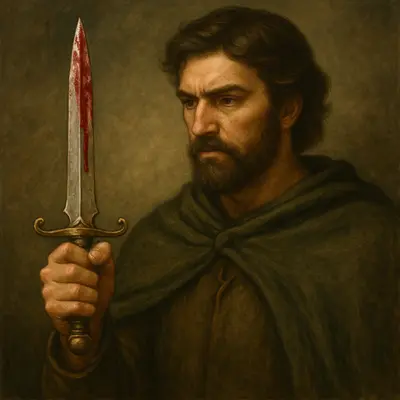
Macbeth: Act 5 – Semi-Long Q&A (5 Marks Each)
Ask Englicist AI about Macbeth
Need help with the summary, themes, meanings, quotes, grammar points, or exam-style answers for this topic? Open StudyMate and ask anything.
Answer within 100-150 words incorporating the details mentioned in (a) and (b).
Q 1. Analyze Lady Macbeth's final scenes and what they reveal about guilt and its psychological effects.
(a) Lady Macbeth sleepwalks and tries to wash imagined bloodstains from her hands
(b) Her descent into madness shows that guilt cannot be escaped through denial or rationalization
Lady Macbeth's final appearance represents a complete reversal of her earlier character. The woman who called upon evil spirits to "unsex" her and remove her conscience is now haunted by that very conscience. She appears sleepwalking, and her doctor observes that she repeatedly tries to wash her hands. She sees imagined bloodstains that no water can remove. Her famous line "Out, damned spot" reveals her desperate attempt to cleanse herself of guilt. She cannot escape the psychological consequences of the murders she helped orchestrate. Lady Macbeth's madness demonstrates that evil acts leave permanent marks on the guilty conscience. Unlike Macbeth, who attempts to suppress guilt through further violence and denial, Lady Macbeth's guilt manifests as mental breakdown. Her sleepwalking confessions reveal her role in Duncan's murder and Banquo's death. She ultimately commits suicide, unable to bear the psychological torment. Lady Macbeth's fate teaches that moral conscience is inescapable. Despite her earlier declarations of strength, she cannot overcome the weight of her crimes. Her death proves that guilt destroys from within, making life unbearable.
Q 2. Explain Macbeth's emotional numbness upon hearing of Lady Macbeth's death and what it reveals about his character.
(a) Macbeth learns his wife is dead but responds coldly, saying she "should have died hereafter"
(b) His inability to grieve shows how tyranny and violence have destroyed his humanity
Macbeth's response to Lady Macbeth's death is shocking precisely because it shows no emotion. He learns that his wife is dead but merely comments that "she should have died hereafter." This cold detachment is the opposite of normal human grief. Macbeth has become emotionally numb from committing so many murders. He has deliberately separated himself from his human emotions to survive as a tyrant. The murders of Duncan, Banquo, and Macduff's family have hardened his heart. By the time of Lady Macbeth's death, he cannot even feel grief for the woman who was once his closest confidante. His emotional numbness reveals how tyranny has dehumanized him. He is no longer capable of normal human feeling. His response to death is indifference rather than sorrow. This numbness also indicates Macbeth's despair. He no longer finds meaning or value in anything, even his wife's life. When he says "she should have died hereafter," he implies that her death was inevitable and meaningless. Macbeth's emotional response—or lack thereof—shows that achieving power through evil has cost him his humanity. He has gained a throne but lost his soul.
Q 3. Discuss Macbeth's "Tomorrow, and tomorrow, and tomorrow" soliloquy and its significance to the play's themes.
(a) Macbeth reflects that life is meaningless, "a tale told by an idiot, full of sound and fury, signifying nothing"
(b) This soliloquy reveals his despair and the emptiness of achieving power through murder
Q 4. Analyze how the witches' prophecies are fulfilled in Act 5 and what this reveals about their manipulative power.
(a) All three prophecies come true: Macduff comes, Birnam Wood moves, and none of woman born kills Macbeth
(b) The prophecies are fulfilled in ways Macbeth does not anticipate, showing the witches' control through language
The witches' prophecies in Act 5 come true exactly as stated but not as Macbeth understood them. The first prophecy, "beware Macduff," comes true when Macduff kills Macbeth in combat. Macduff's personal hatred and superior skill make him the one warrior Macbeth cannot defeat. The second prophecy, "none of woman born shall harm Macbeth," also comes true when Macduff reveals he was born by caesarean section—not born of a woman in the traditional way. The third prophecy, "until Birnam Wood comes to Dunsinane," is fulfilled when Malcolm's soldiers carry branches from the forest as camouflage. All three prophecies are technically true yet delivered in language that Macbeth misinterpreted. This demonstrates the witches' sophisticated manipulation. They speak truth while deliberately using ambiguous language that people interpret according to their desires. Macbeth believed the prophecies guaranteed his safety. Instead, they predicted his downfall. The witches' power lies not in forcing fate but in using language to manipulate human interpretation. They predict what will happen, knowing that Macbeth will misunderstand and act in ways that ensure their prophecies come true. The witches prove more powerful through words than through direct magical force.
Q 5. Explain the significance of Macduff being born by caesarean section and how this detail completes the play's tragic irony.
(a) Macduff reveals he was "from his mother's womb untimely ripped," not born naturally of woman
(b) This revelation allows him to kill Macbeth and fulfills the witches' prophecy in an unexpected way
Q 6. Discuss how Malcolm's restoration and coronation at Scone symbolize the play's resolution and moral message.
(a) Malcolm becomes king and promises to restore order and make Scottish nobles earls
(b) His coronation at Scone represents the restoration of legitimate authority and justice
Malcolm's coronation at Scone represents the triumph of legitimate authority over tyranny. Scone is Scotland's traditional coronation site, making Malcolm's coronation there especially meaningful. It symbolizes a return to proper order and tradition after the chaos of Macbeth's rule. Malcolm's restoration is not merely a change of ruler. It represents the restoration of justice and rightful order. Throughout the play, Macbeth ruled through fear, murder, and paranoia. Malcolm, by contrast, promises to restore order and justice. He makes the Scottish nobles earls, incorporating English customs and creating a new system of nobility. This promise suggests a Scotland that will be more stable and just than under Macbeth. Malcolm's coronation also fulfills the witches' prophecy. Banquo's descendants will eventually become kings, including kings who rule over Scotland and England. Malcolm's association with the English king and English forces foreshadows this future. The play's final message is that evil deeds have consequences. Macbeth murdered his way to power but found only emptiness and eventual defeat. Malcolm, the rightful heir, becomes king through justice and legitimate struggle. The moral is clear: legitimate authority built on justice triumphs over power gained through murder. Malcolm's coronation restores not only the throne but also moral order to Scotland. The play ends not with tragedy for the innocent but with the triumph of goodness and legitimacy.
Q 7. Analyze the role of pace and action in Act 5 and how it differs from earlier acts.
(a) Act 5 consists of short, rapid scenes that accelerate toward the climax
(b) This rapid pace creates tension and builds toward the final confrontation and resolution
Q 8. Discuss the theme of fate versus free will as demonstrated in Act 5 through the prophecies' fulfillment.
(a) The witches' prophecies come true despite Macbeth's efforts to prevent them
(b) Yet Macbeth's free choices cause the prophecies to be fulfilled in unexpected ways
Act 5 presents the final resolution of the play's central question: Is fate predetermined, or do humans have free will? The answer appears to be both. The prophecies come true as predicted. Macduff kills Macbeth. Birnam Wood comes to Dunsinane. Yet these events occur through human actions and free choices. The prophecies do not magically force events to happen. Instead, they predict what humans will choose to do. Macbeth chose to visit the witches. He chose to interpret the prophecies as guarantees of safety. He chose to murder Macduff's family. Each choice stemmed from Macbeth's nature and ambitions. Yet through these choices, the prophecies came true. Macduff's choice to seek revenge against Macbeth fulfills the prophecy that he will be Macbeth's doom. Malcolm's choice to carry branches from Birnam Wood fulfills the prophecy about the forest moving. The prophecies operate through human action. They are not externally imposed but arise from the logical consequences of human choices. Macbeth's attempts to control his fate through violence ensure the fate comes to pass. Had he left Macduff alive, Macduff might not have become his enemy. Had he not ordered the murders, he might have retained more noble support. Yet Macbeth's nature—ambitious, paranoid, and violent—drives him toward the very actions that cause his downfall. Act 5 suggests that prophecy reveals truth about probable outcomes given human nature and circumstances.
Ask Englicist AI about Macbeth
Need help with the summary, themes, meanings, quotes, grammar points, or exam-style answers for this topic? Open StudyMate and ask anything.
Portions of this article were developed with the assistance of AI tools and have been carefully reviewed, verified and edited by Jayanta Kumar Maity, M.A. in English, Editor & Co-Founder of Englicist.
We are committed to accuracy and clarity. If you notice any errors or have suggestions for improvement, please let us know.