Macbeth: Act 1 – Long Q&A (10 Marks Each)
Ask Englicist AI about Macbeth
Need help with the summary, themes, meanings, quotes, grammar points, or exam-style answers for this topic? Open StudyMate and ask anything.
Answer within 200-250 words. Justify your viewpoint or explain by citing textual examples.
Q 1. Compare and contrast the characters of Macbeth and Banquo based on their responses to the witches' prophecies.
Macbeth and Banquo react very differently to the witches' prophecies, revealing fundamental differences in their characters and moral strength. Macbeth is immediately excited and consumed by the prophecies. He begins to imagine what it would be like to be king. He cannot stop thinking about the prediction. His mind races with possibilities about how to make the prophecy come true. He obsesses over the words "yet do I fear thy nature; it is too full o' the milk of human kindness" which Lady Macbeth speaks about him.
Banquo, however, remains skeptical and cautious. He warns Macbeth that the witches may use truth to trap people into evil. Banquo receives his own prophecy—that his descendants will be kings—but he does not become obsessed with it. He does not start planning how to make it happen. Banquo remains loyal and does not turn to evil, even though he has ambition like Macbeth.
This contrast shows that the witches' prophecies alone do not cause Macbeth to murder Duncan. The prophecies are a test of character. Macbeth fails the test because he allows ambition to overwhelm his moral judgment. Banquo passes because he maintains his integrity and loyalty. Macbeth's problem is not that he is ambitious—Banquo is also ambitious—but that Macbeth cannot control his ambition. He allows it to grow into an obsession that leads him toward evil. The prophecies reveal what kind of people Macbeth and Banquo are. Macbeth chooses to act on his ambition. Banquo chooses to remain loyal. Their responses to the same prophecies show that character determines destiny more than prophecy does.
Q 2. Analyze the dramatic irony in King Duncan's judgment and its tragic consequences in Act 1.
Shakespeare creates powerful dramatic irony through King Duncan's poor judgment of character. Duncan himself recognizes his failure when he says he "did not know but honest." He is referring to the previous Thane of Cawdor, who has just been executed for treason. Duncan placed absolute trust in this man, yet the Thane betrayed him. This moment should teach Duncan an important lesson about trusting people too easily.
However, Duncan immediately makes the same mistake again. He transfers the title Thane of Cawdor to Macbeth. The audience watches, knowing that Macbeth will also betray Duncan's trust. Macbeth is already planning Duncan's murder while Duncan is praising him as a loyal soldier. Duncan declares that Macbeth and Banquo have earned rewards for their bravery. He says his "peerless kinsman" has done excellent service. Duncan invites Macbeth to his castle at Inverness.
This is tragically ironic. Duncan is inviting the man who will murder him into his own home. Duncan's blindness to evil and his inability to learn from his mistakes make his downfall inevitable. He places Macbeth in a position of power and trust, not realizing that Macbeth will use this position against him. The audience knows danger is coming, but Duncan does not.
The tragedy is that Duncan is a good man. He is generous, loyal, and trusting. These are good qualities in a king, but they become weaknesses when he cannot see evil in others. Duncan's failure to judge character correctly leads directly to his murder. Shakespeare shows that even good people can have tragic flaws that lead to their destruction. Duncan's trusting nature, which should make him a good king, actually makes him vulnerable to betrayal.
Q 3. Evaluate Lady Macbeth's role in driving the action of Act 1 and determine if she is more ambitious than Macbeth himself.
Q 4. Examine how Shakespeare uses language, imagery, and setting to establish the dark tone of the play in Act 1.
Shakespeare establishes a dark, ominous tone in Act 1 through multiple techniques. The setting itself is ominous. The play begins on a desolate Scottish moor during a violent storm. Thunder and lightning crash above. This wild, dangerous setting immediately establishes that the play will not follow a simple, straightforward path. The environment itself seems hostile and filled with evil.
The witches' language is deliberately strange and mysterious. They speak in riddles and cryptic phrases. They use archaic language that sounds supernatural. They chant rather than speak normally. This unusual language creates an atmosphere of unease. The witches' appearance is also described as strange—"unsex me here"—suggesting they are not quite human. The supernatural setting makes the audience feel that evil forces are at work.
Shakespeare uses blood imagery throughout Act 1 to reinforce the dark tone. The Captain describes Macbeth's battle victory in graphic, violent language. He says Macbeth "unseamed him from the nave to th' chops," describing a brutal, bloody killing. This vivid image of violence foreshadows the murder of Duncan. The repeated use of blood imagery—bloody battles, bloody hands, bloody murder—creates a sense that violence and death will fill the play.
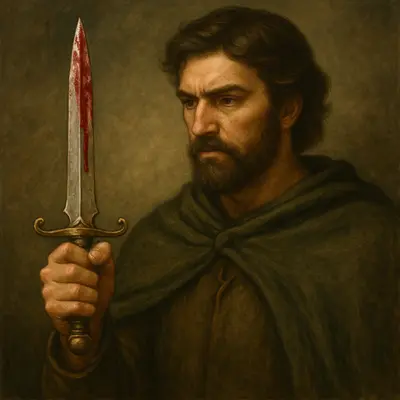
The dagger imagery also contributes to the dark tone. Macbeth's vision of a floating, bloody dagger creates a supernatural, psychological atmosphere. Is the dagger real or imagined? This uncertainty adds to the sense that nothing is quite as it appears. Shakespeare uses these techniques together to create an atmosphere of darkness, danger, and evil that sets the tragic tone for the entire play.
Q 5. Discuss how Macbeth's internal conflict in Act 1 foreshadows his later guilt and descent into madness.
Macbeth experiences significant internal conflict in Act 1 that foreshadows the psychological torment he will endure in later acts. Even as he begins to consider murdering Duncan, Macbeth has serious doubts about the plan. He recognizes that Duncan is his king and his kinsman—people to whom he owes absolute loyalty. He has just sworn to Duncan that his duties are to the throne. Duncan is sleeping in his castle, defenseless.
Macbeth's aside reveals his conflict. He worries that the prophecy might happen without his taking action. He worries about what it means to murder. He questions whether he should trust the witches. Yet despite these doubts, he allows himself to be manipulated by Lady Macbeth. She overcomes his objections by questioning his manhood and offering a detailed plan. Macbeth's inability to stick to his moral principles, even though he recognizes them as correct, shows weakness.
This internal conflict is psychologically damaging. Macbeth knows that murder is wrong. He knows he will betray his king's trust. He knows the deed will change him. Yet he cannot resist the temptation of power offered by the prophecy. This conflict between his moral knowledge and his actions will haunt him. Throughout the play, Macbeth will be tormented by guilt and fear.
The vision of the dagger shows Macbeth's psychological state. His mind is creating images that reflect his inner turmoil. As the play continues, Macbeth will experience more supernatural visions, more sleeplessness, and more psychological breakdown. Act 1 establishes the beginning of this descent. Macbeth's doubt in Act 1 transforms into paranoia and madness in later acts. Shakespeare shows that the mind punishes those who violate their own principles. Macbeth's guilt and psychological breakdown have their roots in this initial conflict between his ambition and his conscience.
Q 6. Explain the significance of the witches' prophecies being partially true and what this reveals about trust and manipulation.
Q 7. Analyze the role of masculinity and how it is used to manipulate Macbeth toward evil in Act 1.
Lady Macbeth uses ideas about masculinity to manipulate Macbeth into committing murder. She suggests that his hesitation to murder Duncan reveals weakness and feminine qualities. She says his nature is "too full of the milk of human kindness," comparing his humanity to feminine weakness. By questioning his manhood, she attacks his self-image and forces him to reconsider his moral objections.
Lady Macbeth's manipulation is effective because Macbeth values his identity as a warrior and man. He has just proven his manhood on the battlefield through brutal, violent combat. Duncan praises his bravery and prowess. Now Lady Macbeth suggests that refusing to commit murder is unmanly. She creates a false choice where Macbeth must either murder Duncan or admit he is not truly a man.
This is psychological manipulation based on gender roles. Lady Macbeth actually removes her own femininity when she calls upon evil spirits to "unsex" her. She suggests that to be strong enough to commit murder, she must abandon feminine qualities. She then tries to make Macbeth prove his manhood by committing the very evil she herself will perform. She wants him to be masculine and strong, but her definition of strength means being capable of betrayal and murder.
Shakespeare shows how ideas about masculinity and femininity can be dangerous. Lady Macbeth uses traditional views of manhood—strength, courage, decisive action—to push Macbeth toward evil. She redefines strength as willingness to commit murder rather than moral courage to resist temptation. She suggests that sensitivity to conscience is feminine weakness. By questioning his manhood, she drives Macbeth to prove himself through violence. Act 1 shows how social constructions about gender can manipulate people into acting against their own moral judgment. Macbeth's need to prove his manhood becomes a weapon used against him.
Q 8. Discuss how Act 1 establishes the supernatural as a central force in the play and its ambiguous role in shaping events.
Ask Englicist AI about Macbeth
Need help with the summary, themes, meanings, quotes, grammar points, or exam-style answers for this topic? Open StudyMate and ask anything.
Portions of this article were developed with the assistance of AI tools and have been carefully reviewed, verified and edited by Jayanta Kumar Maity, M.A. in English, Editor & Co-Founder of Englicist.
We are committed to accuracy and clarity. If you notice any errors or have suggestions for improvement, please let us know.