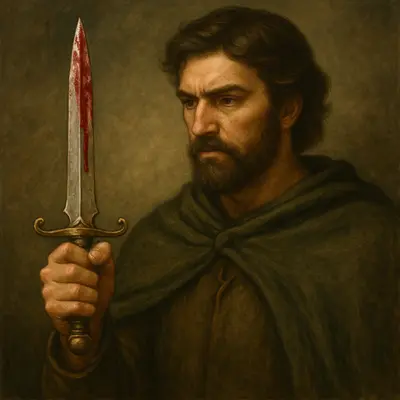
Macbeth Act V Scene 3 Summary
Ask Englicist AI about Macbeth
Need help with the summary, themes, meanings, quotes, grammar points, or exam-style answers for this topic? Open StudyMate and ask anything.
Plot Summary / Story-line
In the hall of Dunsinane Castle, Macbeth strides about issuing military commands, boasting that he has nothing to fear from the approaching armies. He declares that none can harm him because "none of woman born" can do so, and because he will be safe "[t]ill Birnam Wood remove to Dunsinane."
He calls for his servant Seyton, who confirms that an English army of approximately ten thousand soldiers approaches the castle. Despite the distance still remaining before battle, Macbeth insists on donning his armor immediately. He attempts to project confidence and martial readiness.
The doctor enters and reports that Lady Macbeth is tormented by "thick-coming fancies" (disturbing thoughts and visions) that prevent her from sleeping. Macbeth orders the doctor to cure his wife of her delusions, but the doctor honestly responds that the illness is beyond his medical expertise and that she requires spiritual medicine. Macbeth expresses frustration, declaring bitterly that if the doctor cannot cure Lady Macbeth, his services are worthless. Macbeth concludes by ordering the doctor to "throw physic to the dogs," declaring that he will rely instead on his armor and military preparations.
Commentary on Act V, Scene iii
This scene depicts Macbeth in a state of anxious overconfidence, his bravado masking deeper insecurity. His repeated assertions of his invulnerability—based on the witches' prophecies—reveal his fundamental misunderstanding of those prophecies. He interprets "none of woman born" and "Birnam Wood moving to Dunsinane" as literal impossibilities, concluding he is therefore safe. Yet the audience, having witnessed the witches' manipulation and possessing greater wisdom, recognizes these assurances as traps.
Macbeth's insistence on immediately donning armor despite the distance of the approaching army suggests nervous energy and agitation beneath his confident exterior. His rejection of the doctor's concerns about Lady Macbeth reveals both his callousness toward his wife and his inability to comprehend that her mental torment cannot be cured through external means.
His declaration that he will "throw physic to the dogs" represents his rejection of reason, medicine, and moral reflection—he will instead rely on military force and the witches' prophecies. This choice characterizes him as a man unwilling to address the spiritual and moral dimensions of his situation, instead clinging to material force and supernatural assurance. The scene thus portrays Macbeth as simultaneously powerful (commanding armies, donning armor, preparing defenses) and desperately vulnerable (dependent on prophecies he misunderstands, unable to help his wife, surrounded by forces closing in).
Ask Englicist AI about Macbeth
Need help with the summary, themes, meanings, quotes, grammar points, or exam-style answers for this topic? Open StudyMate and ask anything.
Portions of this article were developed with the assistance of AI tools and have been carefully reviewed, verified and edited by Jayanta Kumar Maity, M.A. in English, Editor & Co-Founder of Englicist.
We are committed to accuracy and clarity. If you notice any errors or have suggestions for improvement, please let us know.