Macbeth: Act 1 – Semi-Long Q&A (5 Marks Each)
Ask Englicist AI about Macbeth
Need help with the summary, themes, meanings, quotes, grammar points, or exam-style answers for this topic? Open StudyMate and ask anything.
Answer within 100-150 words incorporating the details mentioned in (a) and (b).
Q 1. Explain the role of the witches' prophecies in awakening Macbeth's ambition.
(a) The witches predict Macbeth will be Thane of Cawdor and King of Scotland
(b) These prophecies plant seeds of ambition that make Macbeth consider taking action to ensure they come true
The witches' prophecies are catalysts that awaken Macbeth's dormant ambition. Before meeting the witches, Macbeth is a loyal general serving King Duncan. The witches' words change everything. They hail him as Thane of Glamis (which he already is), Thane of Cawdor (which he is not yet), and King of Scotland. These prophecies shock Macbeth because they seem impossible. But when Ross immediately announces that Macbeth has indeed been named Thane of Cawdor, the prophecies suddenly seem credible. If two prophecies are coming true, why not the third? Macbeth becomes consumed by the idea of becoming king. The prophecies plant an idea in his mind that grows into overwhelming ambition. Without the witches' words, Macbeth would likely have remained a loyal subject. The prophecies ignite his desire for power and push him toward considering murder. Shakespeare shows that Macbeth does not need external force—the prophecies simply awaken desires already within him, making him question his destiny and his role in shaping it.
Q 2. Analyze Lady Macbeth's character and her influence over her husband in Act 1.
(a) Lady Macbeth reads Macbeth's letter and immediately resolves to help him become king
(b) She questions his manhood and manipulates him into committing murder
Lady Macbeth emerges as a powerful, ambitious character willing to do whatever is necessary to seize power. Upon reading Macbeth's letter about the prophecy, she does not hesitate or doubt. She immediately begins plotting Duncan's murder. She worries that Macbeth is "too full of the milk of human kindness" to kill Duncan himself. This concern reveals her understanding of her husband—he has ambition but lacks ruthlessness. Lady Macbeth is willing to provide the ruthlessness he lacks. She calls upon evil spirits to fill her with cruelty and remove her feminine compassion. She then manipulates Macbeth by questioning his manhood, implying that only a weak man would hesitate to murder. She creates a detailed plan to kill Duncan by getting his guards drunk and blaming them for the murder. Lady Macbeth demonstrates that she is the stronger character, driving the action while Macbeth struggles with doubt. She uses emotional manipulation and insults to overcome his moral objections, showing that ambition is not Macbeth's only problem—it is her influence that pushes him toward evil.
Q 3. Explain Banquo's reaction to the witches' prophecies and his difference from Macbeth.
(a) Banquo warns Macbeth that evil spirits speak truth to manipulate people into harm
(b) Banquo remains cautious while Macbeth becomes consumed by ambition
Q 4. Discuss King Duncan's tragic error in judgment and how it sets up the play's tragedy.
(a) Duncan trusts the previous Thane of Cawdor who later betrays him
(b) Duncan immediately places similar trust in Macbeth, who will also betray him
King Duncan makes a critical error in judgment that sets up the tragedy of the play. The Captain reports that the previous Thane of Cawdor has been defeated and executed for treason. Duncan muses that he had placed "absolute trust" in this man, yet the Thane betrayed him. This statement reveals Duncan's tendency to trust too easily and judge character poorly. Immediately after hearing this, Duncan decides to give Macbeth the same title and position. Duncan does not learn from his mistake with the previous Thane. He is so pleased with Macbeth's bravery in battle that he fails to see potential danger. Shakespeare uses dramatic irony here—the audience senses that Macbeth may betray Duncan just as the previous Thane did. Duncan's blindness to human nature and his inability to recognize evil sets up his own murder. He places Macbeth in a position of trust and power, never suspecting that Macbeth will use this position to commit regicide. Duncan's tragic flaw is his naive trust in others. He rewards loyalty with honors, expecting loyalty in return, but he fails to see that ambition can corrupt even brave soldiers. This misjudgment directly enables Macbeth's rise to power.
Q 5. Analyze the conflict between fate and free will presented in Act 1.
(a) The witches' prophecies suggest a predetermined fate
(b) Macbeth's choices to act on the prophecies show his own free will and responsibility
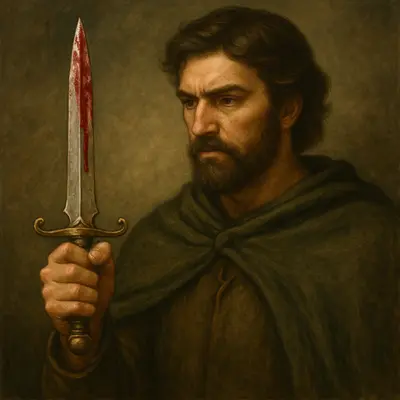
Q 6. Explain what the dagger imagery represents in Act 1 and how it foreshadows the murder.
(a) Macbeth imagines a bloody dagger in the air before Duncan's murder
(b) The dagger symbolizes murder, violence, and the tool Macbeth will use to commit his crime
The dagger imagery in Act 1 is significant because it symbolizes the violence Macbeth is about to commit. When Macbeth has a vision of a floating dagger in the air, he is torn between murder and loyalty. The dagger appears as if supernatural forces are pushing him toward violence. Whether the dagger is real or imagined, it represents the instruments of darkness at work in Macbeth's mind. He cannot escape the vision because he cannot escape his growing ambition for murder. The dagger foreshadows the actual murder weapon he will use to kill Duncan. It also symbolizes his internal conflict—Macbeth sees the blood that will stain his hands and the moral price he will pay for murder. The dagger is both temptation and warning. It lures him toward the evil act while also showing him the bloody consequences. Throughout Act 1, weapons and blood are frequently mentioned, establishing a pattern of violent imagery that dominates the play. The supernatural appearance of the dagger suggests that Macbeth's descent into evil is not entirely rational or within his control. Dark forces seem to conspire to push him toward murder, yet the dagger also represents his own desire for power made visible. The dagger imagery shows Shakespeare's genius in using symbols to reveal both external supernatural pressure and internal psychological conflict.
Q 7. Discuss how Act 1 establishes the theme of unchecked ambition and its dangers.
(a) Macbeth's ambition grows from the witches' prophecies and is inflamed by Lady Macbeth
(b) His unchecked desire for power leads him to consider murder of his own king
Q 8. Examine how supernatural elements create atmosphere and influence the action in Act 1.
(a) The witches appear in thunder and lightning, speaking mysteriously about prophecy and fate
(b) Their supernatural presence creates an ominous tone and seems to influence Macbeth's actions
The supernatural elements in Act 1—the witches, their mysterious prophecies, and the ghostly dagger—establish the dark, ominous atmosphere that dominates the entire play. The witches appear during a violent storm, immediately associating them with chaos and unnatural forces. They speak in riddles and chanting tones, creating an eerie atmosphere. Their prophecies seem to come from a source beyond normal understanding. This supernatural setting makes the audience feel that something evil is unfolding. The witches' ability to predict Macbeth's promotion to Thane of Cawdor seems to give their prophecies credibility. The supernatural element makes the audience wonder about the nature of fate and whether humans can control their own destinies. The dagger that Macbeth sees before the murder adds to the supernatural atmosphere—is it real or is it a vision sent by evil forces? The supernatural elements blur the line between reality and illusion, between what Macbeth imagines and what actually happens. This creates psychological tension. The witches and the dagger do not directly force Macbeth to commit murder, but they create an atmosphere in which evil seems possible and even inevitable. The supernatural setting suggests that dark forces in the universe are at work, either testing Macbeth or trying to manipulate him. Whether supernatural forces actually exist or exist only in Macbeth's mind, they effectively establish the tragic tone of the play.
Ask Englicist AI about Macbeth
Need help with the summary, themes, meanings, quotes, grammar points, or exam-style answers for this topic? Open StudyMate and ask anything.
Portions of this article were developed with the assistance of AI tools and have been carefully reviewed, verified and edited by Jayanta Kumar Maity, M.A. in English, Editor & Co-Founder of Englicist.
We are committed to accuracy and clarity. If you notice any errors or have suggestions for improvement, please let us know.